
A week has passed since the conclusion of Wimbledon, making it the perfect time to look back at one of the most iconic sporting events in the world.
For many years now, the Championships have been far more than just a tennis tournament. For two weeks, the grounds of the All England Club transform into a world of their own, with unmistakable traditions and timeless elegance: perfectly manicured grass, the players’ all-white dress code, strawberries and cream, the famous ticket queue, and the almost sacred silence before every serve.
Behind that elegance, however, lies a sporting operation of remarkable scale. Following the conclusion of Wimbledon 2026, the organisers released the tournament’s key statistics, and some of the numbers offer an entirely new perspective on what took place in London.
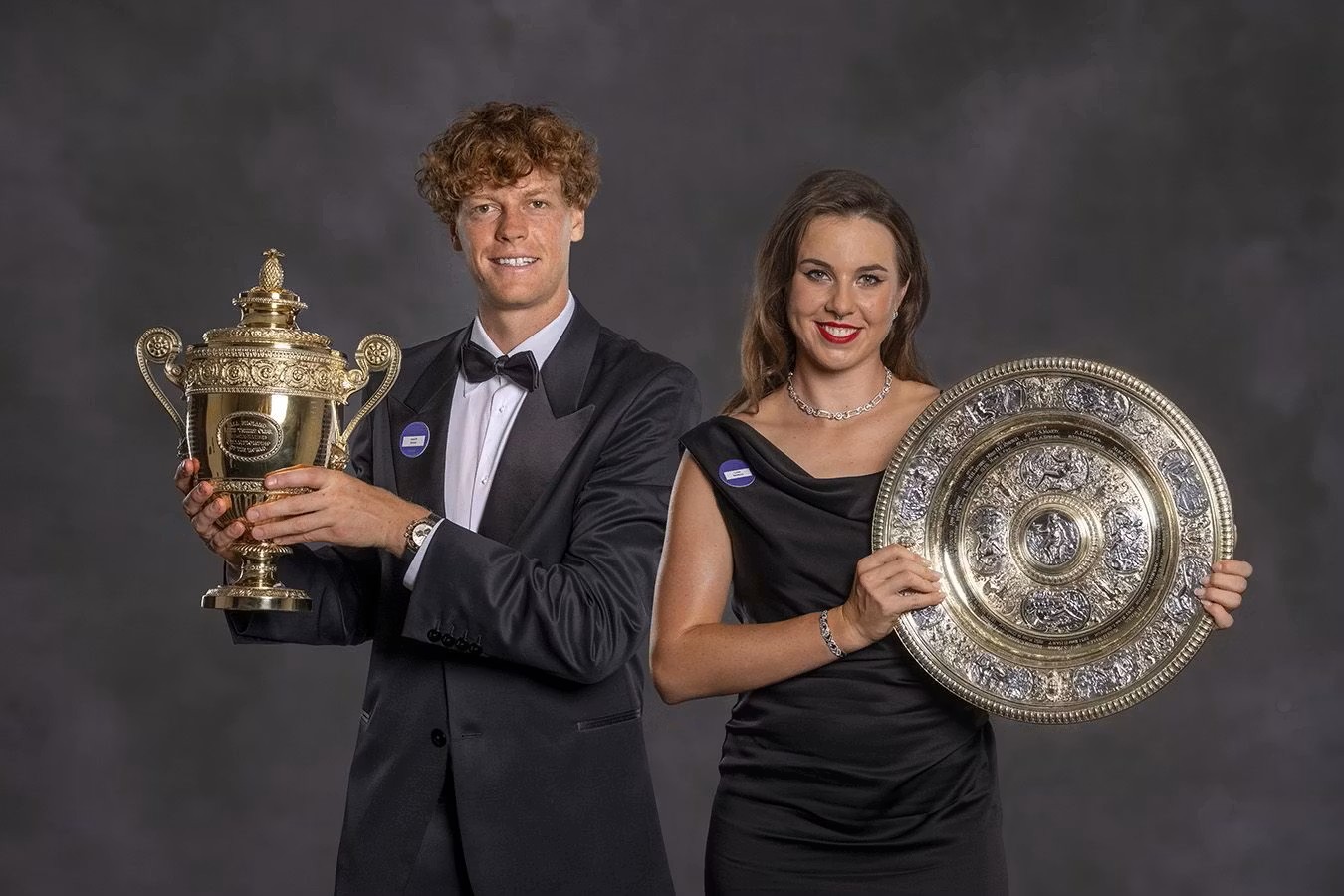
The singles titles were won by Jannik Sinner and Linda Nosková. The Italian successfully defended his Wimbledon crown, while the Czech star claimed the biggest title of her career, lifting the famous Venus Rosewater Dish. Held from 29 June to 12 July, Wimbledon once again served as the third Grand Slam tournament of the season.
Yet the story of Wimbledon 2026 extended far beyond its two singles finals.
Over the course of the fortnight, 550,151 spectators passed through the gates of the All England Club, setting a new attendance record for the Championships. In other words, during just fourteen days of competition, Wimbledon welcomed a crowd comparable to the population of a major European city.
A total of 1,318 hours of tennis were played across the tournament. Watching every minute without stopping for sleep, meals or any other unavoidable human necessity would have required almost 55 consecutive days.
Players across all events contested 18,130 games and produced 45,182 rallies. In addition, organisers recorded another 3,823 games played in the junior singles and doubles competitions. These figures illustrate the true scale of Wimbledon. While fans naturally remember Centre Court and the championship matches, dozens of compelling stories unfold simultaneously across the rest of the grounds.
Exactly 7,000 aces were served during Wimbledon 2026. The fastest serve belonged to Argentina’s Thiago Agustín Tirante, whose delivery reached 148 mph (approximately 238 km/h). At that speed, by the time the returner realises the ball has been tossed, it is already halfway to the back fence.
The Championships required 15,456 tennis balls, while 282 ball boys and ball girls worked throughout the event after months of rigorous training and selection. Their efficiency often goes unnoticed, which is perhaps the greatest compliment of all. At Wimbledon, flawless organisation is designed to look effortless.
The longest match of the tournament lasted 5 hours and 15 minutes. In the quarter-finals, Novak Djokovic defeated Félix Auger-Aliassime 7-6, 3-6, 6-3, 6-7, 7-6. Finishing at 10:52 p.m., it became the longest men’s quarter-final in Wimbledon history. For the 39-year-old Serbian, however, it was only one more obstacle before facing Jannik Sinner in the semi-finals two days later.
The Championships also produced a number of remarkable stories.
Britain’s Arthur Fery, competing on a wild card, became the first British men’s singles wild card in the Open Era to reach the Wimbledon semi-finals. His unforgettable run became one of the biggest surprises of the tournament and captivated the home crowd.
The Philippines’ Alexandra Eala made history as the first player from her country to reach the fourth round at Wimbledon. Her stunning victory over defending champion Iga Świątek made headlines around the world. Although her dream run ended in the following round, it became a landmark sporting achievement for a nation of around 120 million people.
Britain’s Henry Patten also entered the history books by becoming the first British player in the Open Era to win the Wimbledon men’s doubles title twice. In the country that considers Wimbledon its greatest sporting tradition, such an achievement carries special significance.
In wheelchair tennis, Japan’s Yui Kamiji finally captured her maiden Wimbledon singles title, completing the Career Golden Slam by winning all four Grand Slam tournaments as well as the Paralympic Games. She defeated Diede de Groot 6-0, 6-0 in the final.
The organisers also celebrated an important milestone: 50 years since Brad Parks founded wheelchair tennis. Today, wheelchair events are an integral part of Wimbledon, with finals staged on the tournament’s biggest courts before large audiences.
One final statistic was almost as remarkable as any match result. For the first time since 2019, not a single match was interrupted by rain. At Wimbledon, where the weather forecast is often followed almost as closely as the draw itself, that is a record in its own right.
Yet statistics alone cannot explain the enduring magic of Wimbledon.
People do not travel to London simply to count aces or games won. They come to witness a young player stepping onto Centre Court for the very first time, a favourite surviving within a few points of defeat, or an unknown junior beginning a journey that may one day lead to lifting one of tennis’ most prestigious trophies.
That is precisely why these numbers matter, especially for young tennis players. They remind us that a great tournament is not defined solely by its finals or trophy ceremonies. Every victory is built upon thousands of rallies, countless hours of practice, and the dedication of coaches, officials, ball kids, organisers and many other professionals whose work often remains invisible to spectators.
Wimbledon 2026 is now part of history. New champions have etched their names onto the honours boards, the grass behind the baselines on Centre Court has once again been worn away, and more than half a million fans have returned home.
For young tennis players around the world, however, the Championships may have marked the beginning of a new dream. Somewhere, a child watched a Wimbledon final for the first time and quietly thought:
“One day, I want to walk onto that court.”