
Club, national calendar, Tennis Europe, ITF, Challenger, ATP and WTA — for parents of a young tennis player, these names quickly turn into a string of letters and numbers. In Part One, we look at who is responsible for what and what the path from a child’s first matches to the professional tour really looks like.
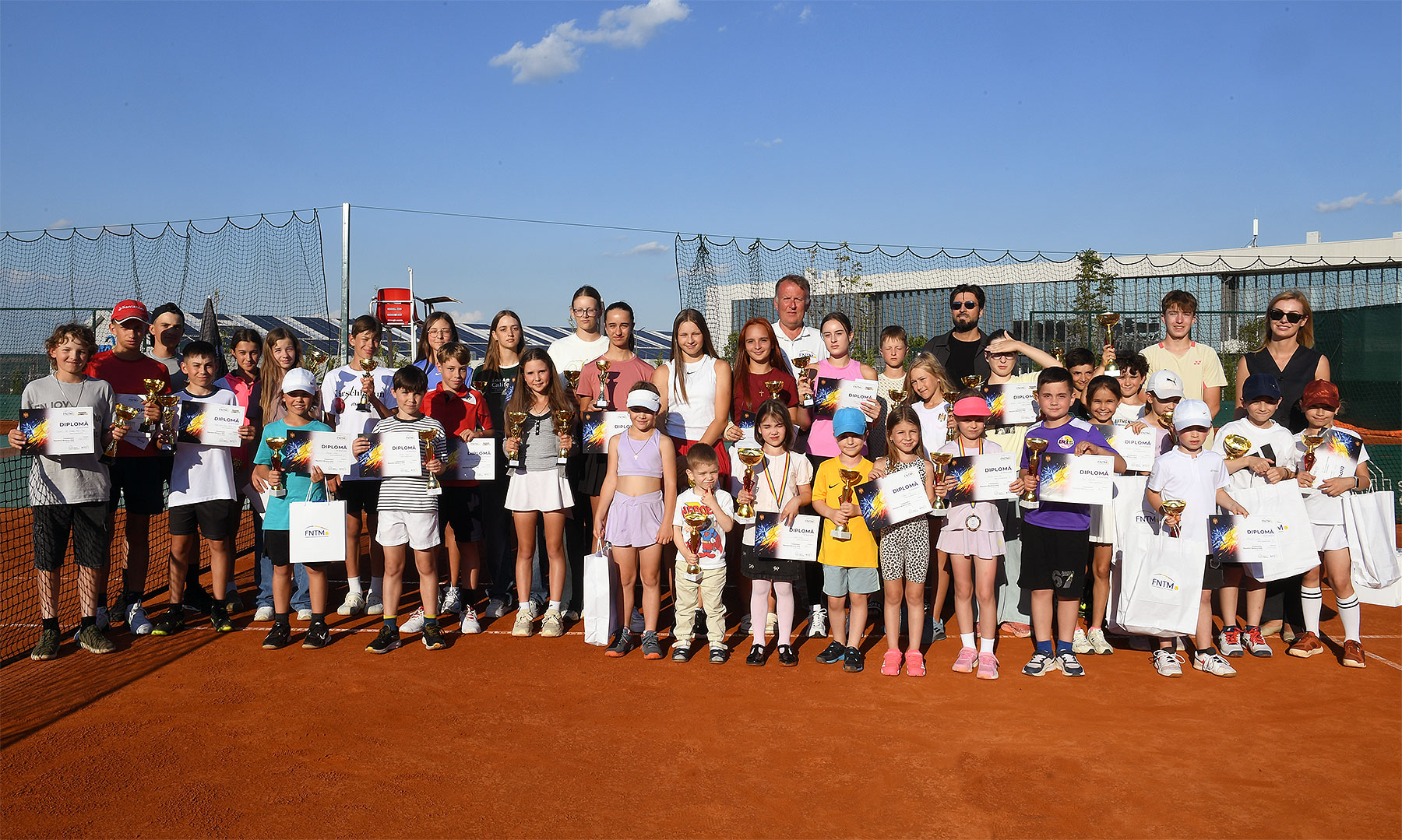
Parents of a child who starts playing tournaments soon encounter a whole set of unfamiliar terms: club tournament, national ranking, Tennis Europe Category 2, ITF J60, W15, Challenger 75, ATP 250… At first glance, they may all seem to be parts of one large calendar, with competitions simply differing in scale. In reality, tennis is more complex: different organisations operate at different stages, there are different rankings and entry systems, and moving to the next level does not always mean that the previous one must be left behind immediately. We explain what a player’s path looks like — from the first matches at their own club to the professional tour.
It is useful to begin with the main principle: tennis does not have one single tournament system that takes a child from the age of eight to Wimbledon. There are several levels that successively overlap. Within a country, competitions are organised by clubs and the national federation. The international junior level in Europe begins with Tennis Europe. Next comes the worldwide ITF junior tour. After that, a player can move into the professional ITF World Tennis Tour, followed by the ATP Challenger Tour, the WTA Tour and the ATP Tour. The Grand Slams occupy a special place: they are the biggest tournaments in world tennis and are not regular ATP or WTA tournaments, although their results count towards the professional rankings.
The very first level is club and local competitions. This is the best place for a child to begin tournament play. Such tournaments are usually organised by tennis clubs, academies, municipal bodies or regional organisations. In particular, weekend tournaments for young tennis players are organised by the National Tennis Centre (www.ntc.md). Their main purpose is not an international ranking, but match experience: learning to keep score independently, cope with nerves, play unfamiliar opponents, wait for a match, warm up without constant help from a coach, and understand that competition is very different from ordinary practice.
ntc.md
For a beginner, the quality of such matches is often more important than the status of the tournament. Travelling hundreds of kilometres to lose 0:6, 0:6 may provide far less value than four evenly matched contests at a tournament close to home. That is why one of the first principles of a sensible calendar is simple: a player should first learn how to compete, and only then travel in order to compete.
The next level is official national competitions. Their structure is determined by the national federation of each country. This is where age groups, a national calendar and a national ranking first appear. The system may differ from one country to another: some countries have several tournament levels, some have separate regional and national categories, and some use additional measures of player strength.
fntm.md
Parents should therefore avoid applying one country’s system to another. A tournament at a particular level in France, Romania, Moldova or the United Kingdom may have entirely different entry rules and methods of awarding points. Yet the function of the national system is broadly the same everywhere: it creates a bridge between club tennis and international competition.
This is where the first common parental misconception appears: “If a child has already played an international tournament, why do they still need national events?” In most cases, this is the wrong question. International status alone does not make a tournament more useful. If national competitions give a child more evenly matched contests and the chance to face the strongest opponents at their level, they may remain a crucial part of the calendar for several more years.
First International Level: Tennis Europe
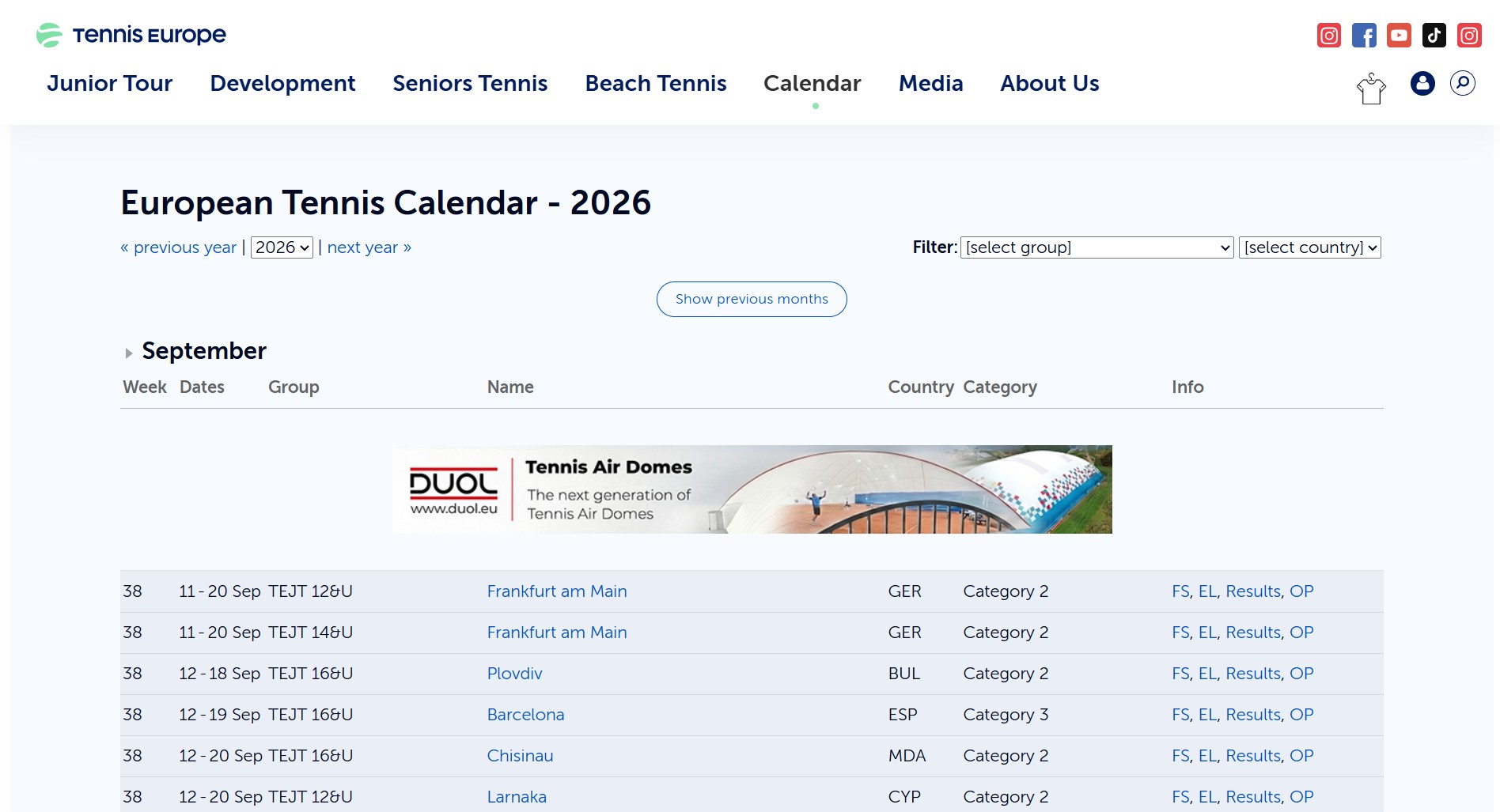
For a European player over the age of 10, the next major level is the Tennis Europe Junior Tour. Tennis Europe is the regional governing body for tennis in Europe, and its Junior Tour is intended primarily for the 12&U, 14&U and 16&U age groups. Tennis Europe itself describes this system as the next step after national competitions.
tenniseurope.org
For 14&U and 16&U tournaments, there is a clear grading system: Category 3, Category 2, Category 1 and Super Category. Category 3 is the more accessible international level, after which the difficulty and prestige increase. Super Category is the highest tier of the regular Tennis Europe calendar; the organisation itself compares these events to the unofficial “Grand Slams” of the European junior tour.
In addition to individual tournaments, there are European Championships, the Junior Masters and team competitions — the Winter Cups and Summer Cups. Here, a child can compete not only for themselves, but also for their national team. It is through these competitions that many future professionals first experience representing their country.
Parents need to understand that Category 3 is lower than Category 1 only in formal classification, but is not necessarily worse for a particular child. For a player who is just entering Tennis Europe, victories and several strong matches at a Category 3 event will often provide far more value than repeated first-round defeats at Category 1 events.
Another term that parents begin to hear fairly early is IPIN. It stands for International Player Identification Number — an international player identifier used in international competition systems. Tennis Europe explicitly states that players use IPIN to manage tournament entries and withdrawals.
In practice, IPIN is not simply a number that is obtained once and then forgotten. To compete internationally, a player creates a profile in the ITF system, enters their basic information, and then uses that profile to manage tournament entries. From the outset, parents should treat this account as a working tool: they need to ensure that the information is correct, maintain access to the email address, monitor notifications and keep the registration status valid. Specific requirements and fees may change, so they should be checked in the current IPIN system and tournament regulations before the player’s first international season.
Parents should remember that international tournament life begins not with buying tickets, but with a properly set up player profile and an understanding of the entry rules.
Worldwide Junior Tour: ITF Juniors
The next level is the ITF World Tennis Tour Juniors. This marks the beginning of a worldwide, rather than solely European, junior calendar. In 2026, it includes six main tournament levels: J30, J60, J100, J200, J300 and J500, with the Junior Grand Slams above them. The ITF identifies J30 as the lowest level and J500 as the highest among the tour’s regular tournaments.
itftennis.com
The logic behind the names is simple: the letter J stands for Junior, while the number indicates the tournament category and also serves as a guide to the number of ranking points awarded to the winner. The higher the number, the stronger the field tends to be, the higher the organisational requirements, and the more difficult it is to gain entry.
This is where the full ITF Junior Ranking begins. In 2026, the ranking is calculated on results from the previous 52 weeks: it includes the six best singles results plus one quarter of the points from the six best doubles results. This explains why strong junior players continue to take doubles seriously — doubles results genuinely affect the overall ITF Junior Ranking.
There is an important age restriction. In 2026, a player must be at least 13 years old on the first day of the singles main draw to compete in ITF World Tennis Tour Juniors tournaments. A player may compete on the junior tour until the end of the year in which they turn 18.
At the top of the junior system are the Junior Grand Slams — the Australian Open, Roland Garros, Wimbledon and the US Open — and the J500 tournaments. The ITF explicitly identifies the Grand Slams as the most prestigious competitions on the junior tour, together with the seven J500 tournaments.
This brings us to a fundamentally important point: the junior ranking and the professional ranking are different rankings. Victories at J30 or J300 events do not automatically become ATP or WTA points. Junior tournaments help a player develop, gain international experience and build an ITF Junior Ranking, but to earn a professional ranking the player must begin competing in adult events.
When Professional Tennis Begins
The next level is the ITF World Tennis Tour, the entry-level international professional tour. This is where a junior first enters a tournament alongside adult professional players and begins competing for ATP or WTA points and prize money.
On the men’s side, the basic professional categories are M15 and M25. On the women’s side, they are W15, W35, W50, W75 and W100. This is the structure used for the professional World Tennis Tour in the current ITF organisational requirements for 2026.
The letter indicates the gender: M stands for Men and W for Women. The number indicates the tournament category. For example, W15 is the entry level of women’s international professional tennis, while W100 sits immediately below the WTA 125 level.
At this point, it is particularly important for parents to abandon the illusion that the word “professional” automatically means high earnings. At the lower levels of the professional tour, the cost of travel, hotels, coaching, food and medical support may be considerably higher than the prize money earned. The first years of professional tennis are more of an investment stage in a player’s career.
After M15 and M25, the men’s system progresses to the ATP Challenger Tour. These competitions are already held under the auspices of the ATP and form the crucial intermediate level between the ITF and the main ATP Tour. In 2026, the categories are Challenger 50, 75, 100, 125 and 175. The winners receive 50, 75, 100, 125 and 175 ATP ranking points respectively.
This is why Challenger 50 cannot simply be called “another ITF tournament”. Organisationally and competitively, it is already part of the next system. These tournaments may feature young players just making their way up, players who were recently ranked inside the ATP top 100, and experienced professionals rebuilding their ranking after injury.
In the women’s game, WTA 125 events largely fulfil the role of a similar intermediate level, followed by WTA 250, WTA 500 and WTA 1000. The official WTA classification uses these levels; WTA 125 also remains a separate category on the calendar.
The main men’s ATP Tour consists of ATP 250, ATP 500 and ATP Masters 1000 events. Above them in the sporting hierarchy are the four Grand Slam tournaments. This is how the ATP describes the upper part of the men’s tournament pyramid.
At the top level, the women’s structure is very similar: WTA 250, WTA 500 and WTA 1000, plus the Grand Slam tournaments. The 2026 WTA calendar includes 10 WTA 1000 tournaments, 17 WTA 500 tournaments and 22 WTA 250 tournaments.
In simplified form, the pathway looks like this:
club → national competitions → Tennis Europe → ITF Juniors → ITF World Tennis Tour → ATP Challenger/WTA 125 → ATP/WTA Tour → Grand Slam.
However, the word “ladder” can be slightly misleading here. A player does not have to complete one level entirely before moving to the next. In the same year, a strong 15–16-year-old player may compete in Tennis Europe, ITF Juniors and their first professional tournaments. An older junior may spend part of the season at J100/J200 events and another part at M15 or W15 events. It all depends on the player’s ranking, age, level of play and development strategy.
Moving to the next level does not mean that the previous one must be left behind immediately. The levels overlap, and the right tournament is not necessarily the one in the highest category, but the one that matches the player’s current objective.
…continued in Part Two.