
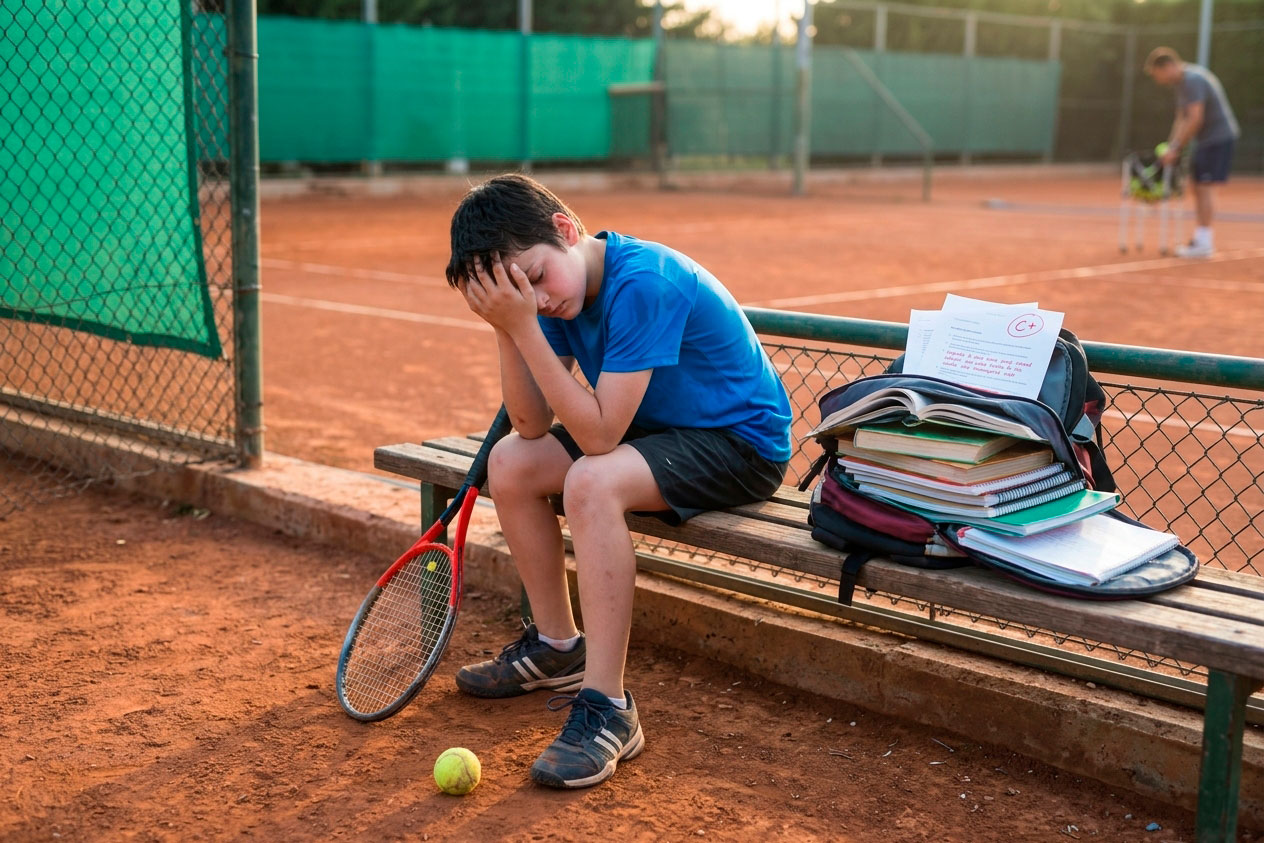
And now school is back… After six or seven lessons, a student heads to practice. There are another two hours on the court ahead, and homework is waiting at home. Why can even a well-prepared young tennis player lose concentration, make mistakes in simple situations and become irritable on days like these? And what can parents and coaches do to keep school and sport from turning into an endless race?
Imagine a typical day in the life of a young tennis player. In the morning, the child goes to school, answers questions at the board, takes a test and spends time with classmates. After lessons, the child has a quick snack, changes clothes and heads to practice.
The coach feeds the first ball. The child is late to the shot, makes a mistake and does not immediately understand the drill. Just yesterday, the same exercise caused no particular difficulty. From the outside, it may seem that the player is not trying hard enough. But before demanding more effort, it is worth remembering what the child has been doing for the past seven hours.
The demands of school are not limited to the time spent sitting at a desk. Tests, homework, relationships with classmates and worries about grades all require attention and emotional energy. By the time practice begins, a child may already be tired, even after spending most of the day barely moving.
At the same time, school and tennis should not compete with each other. The adults’ role is to help the child organize the day so that there is enough energy for school, sport and everyday life.
Preparation Begins Long Before Stepping onto the Court
One source of additional stress is unfinished business. If a child knows that the evening will be spent preparing for a test the next day, that thought may linger throughout the entire practice. The solution is not necessarily to finish all homework before tennis. Sometimes that is impossible. It is far more helpful to know in advance what needs to be done that day, how long it will take and exactly when the child will be able to work on it.
Parents can help with planning, but they should not take over the entire task. Gradually, the student needs to learn to assess the workload, pack a sports bag, keep track of the schedule and manage time. This independence will also be useful at competitions, when there may be no one nearby ready to solve every organizational problem.
Lunch and a Bottle of Water Are Part of the Preparation Too
Children often arrive at practice hungry after school. Many hours may pass between breakfast and the first shot on court, while a proper lunch is replaced by a random snack.
Not eating or drinking enough can make physical exercise and sustained concentration more difficult, especially when practice takes place in hot weather or includes extended match-play drills.
Parents should think through what the child will eat during the school day and when the child will have a meal before practice. The child should have an opportunity to eat lunch, drink water and, if necessary, have a snack, taking into account how much time remains before stepping onto the court.
There is no universal menu: individual needs depend on age, the length of the training sessions and personal characteristics. But it is unreasonable to expect a student to complete an intensive practice at full capacity after spending almost the entire day without food.
There Should Be a Break Between School and Practice
Sometimes the schedule looks like this: the final bell, the car, a change of clothes, the court. The child is literally transferred from one demanding environment to another.
Whenever possible, it is worth leaving a short interval between the two. The child can eat, change without rushing, take a short walk or simply sit for a while without immediately having to complete yet another task. Finally, a chance simply to relax.
The same way of switching gears does not suit every child. One may want to talk about the school day, while another may need a few minutes of silence. Parents do not have to discuss grades on the way to practice, especially if the conversation is likely to be unpleasant. It can be moved to another time.
Gradually, the young athlete learns to shift attention. At school, the focus is on mathematics and languages; on the court, it is on the ball, movement and the coach’s instructions. This does not mean that worries about school can be switched off on command. But a calm transition between activities helps avoid adding yet another source of stress to the existing demands.
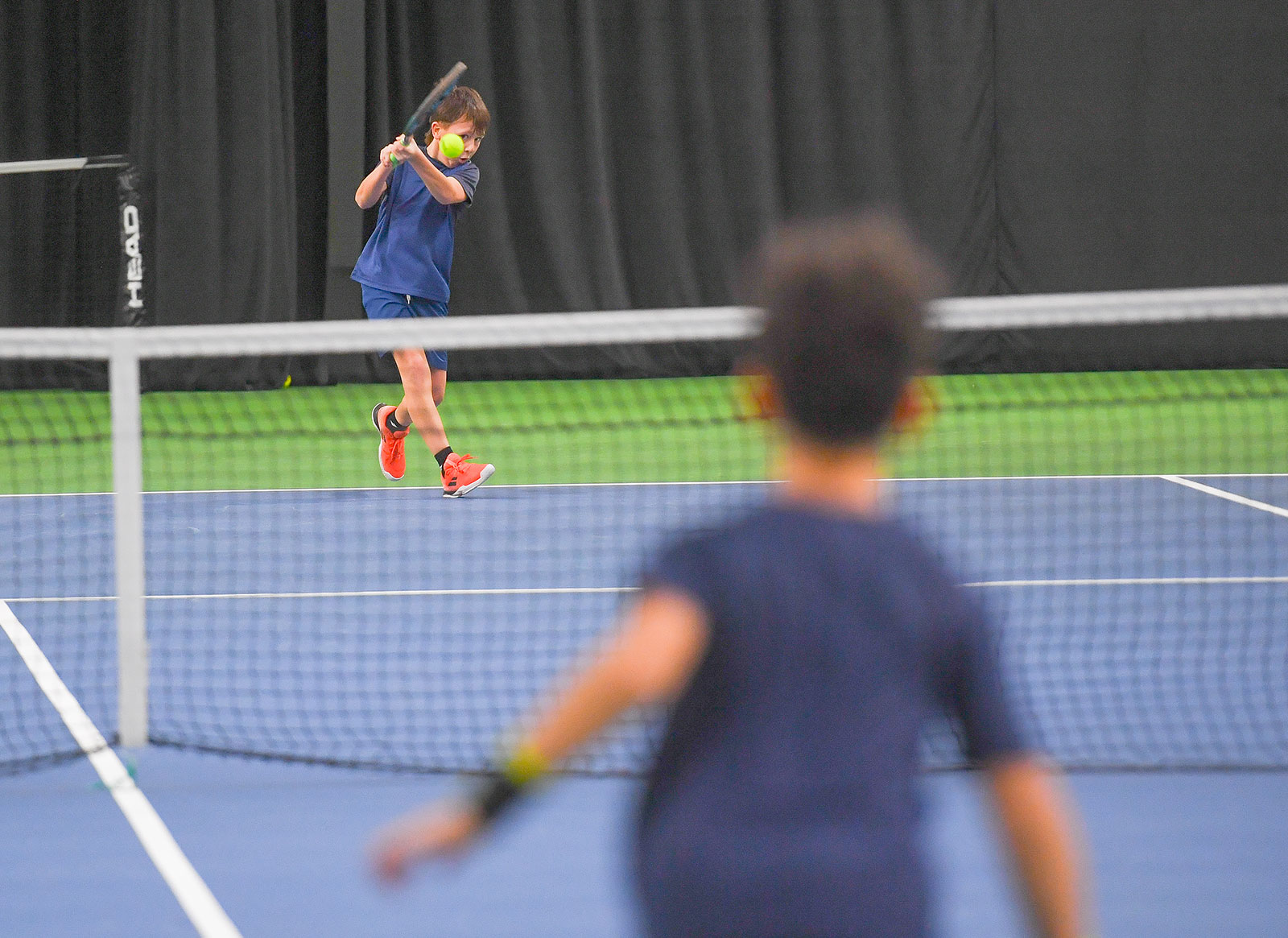
© Serghei Visnevschii / FNTM
Practice After School Does Not Have to Be the Same as Practice on a Day Off
A coach sees the player in the group on the court but does not always know what kind of day the player has had. One student has taken a test. Another slept poorly. A third has arrived after extra classes and is already noticeably tired. One did not manage to eat properly; another is distracted by thoughts that have nothing to do with practice.
That is why it can be helpful to begin practice with a brief assessment of the athletes’ condition. Sometimes it is enough to ask how a player feels and observe how attentively the first exercises are performed.
A warm-up can help the child ease into the work. But if the child is clearly exhausted or complains of dizziness, pain or unusual weakness, the coach’s task is not to force the child to push through these symptoms, but to understand what is happening and, if necessary, stop the session.
Ordinary tiredness after a school day and signs of excessive strain are not the same thing.
Of course, a young tennis player must learn to compete in less-than-ideal conditions. Tournaments bring early matches, delays, heat, and difficult and stressful situations on court. The ability to maintain focus while moderately tired is genuinely necessary.
However, this ability should be developed gradually. Constant exhaustion is not a necessary part of athletic preparation.
Sleep Should Not Be Sacrificed to the Schedule
Evening practice ends, the child returns home, eats dinner and sits down to do homework. If the assignments take too long, sleep time is reduced.
The next day, it all happens again.
A lack of sleep can affect attention, mood, recovery and physical performance. For a growing athlete, this is especially significant.
If a child regularly goes to bed late because of the combination of school, tennis and homework, the problem should be sought in the schedule, not in a lack of discipline.
Sometimes the practice time, the number of extra classes or the competition schedule will need to be reconsidered. Older students may face periods of increased academic pressure, for example before exams. During such weeks, it is sensible to coordinate the sports plan with the academic calendar.
A good schedule is not one in which every free minute is occupied, but one that the child can sustain over a long period.
Do Not Turn the Journey Home into a Review of Mistakes
After a difficult school day and practice, the child gets into the car. The parent immediately asks why the serve was not working, why there were so many forehand errors and whether the child listened carefully enough to the coach.
The comments may be justified. But the timing of the conversation is poor.
The child should have a chance to finish practice and recover emotionally. If the child wants to discuss the session, listen. If not, technical mistakes are best left to the coach, and a conversation about results can wait.
It is especially important not to link setbacks in sport with setbacks at school: a poor grade should not become an additional argument in a dispute about a lost match, and vice versa.
A child should not have to prove success in two areas at once every single day.
There Should Be Time When Nothing Has to Be Achieved
School, tennis, homework, tournaments at weekends. In a schedule like this, it is easy to lose what adults sometimes consider optional: free time.
Time with friends, walks, games and activities unrelated to grades or sporting results remain part of childhood.
If every weekend is taken up by competitions and weekdays by lessons and practice, it is worth checking from time to time how satisfied the child is with this routine. Does the child still go to the court with interest? Is there an opportunity to rest? Has tennis come to feel like yet another obligation that cannot be questioned?
These questions are especially important during adolescence, when both academic expectations and training loads increase.
Parents and Coaches Should Talk to Each Other
The coach may not know that the player has begun an exam week. The parents may have no idea how intense that day’s practice was.
As a result, the child is caught between two schedules that have been drawn up independently of each other.
A simple exchange of information helps prevent situations like these. Before a period of tests, the practice schedule can be discussed in advance. Before an important tournament, everyone can work out how to organize school assignments and travel without leaving everything until the final evening.
The child should also take part in the conversation. The child’s view of the workload and well-being is no less important than the adults’ plans.
Most children who play tennis will not become professional athletes. But even for those pursuing a professional career, education, health and well-rounded development should not be pushed into the background.
The ability to plan the day, prepare for lessons and practice, handle organizational matters independently and recognize tiredness in time will benefit a child regardless of how far the child progresses in tennis.
And if, after a difficult day at school, a young player steps onto the court and performs below the usual level, that is not yet a reason to question the child’s attitude toward the sport. Sometimes what the child needs is not more demands, but lunch, a short rest and adults who understand how much has already happened during the day.