
Just twenty years ago, rain was considered the main weather problem at tennis tournaments. It disrupted schedules, forced organizers to close courts, and postpone matches. Today, the situation is gradually changing. Extreme heat is increasingly becoming the main threat.
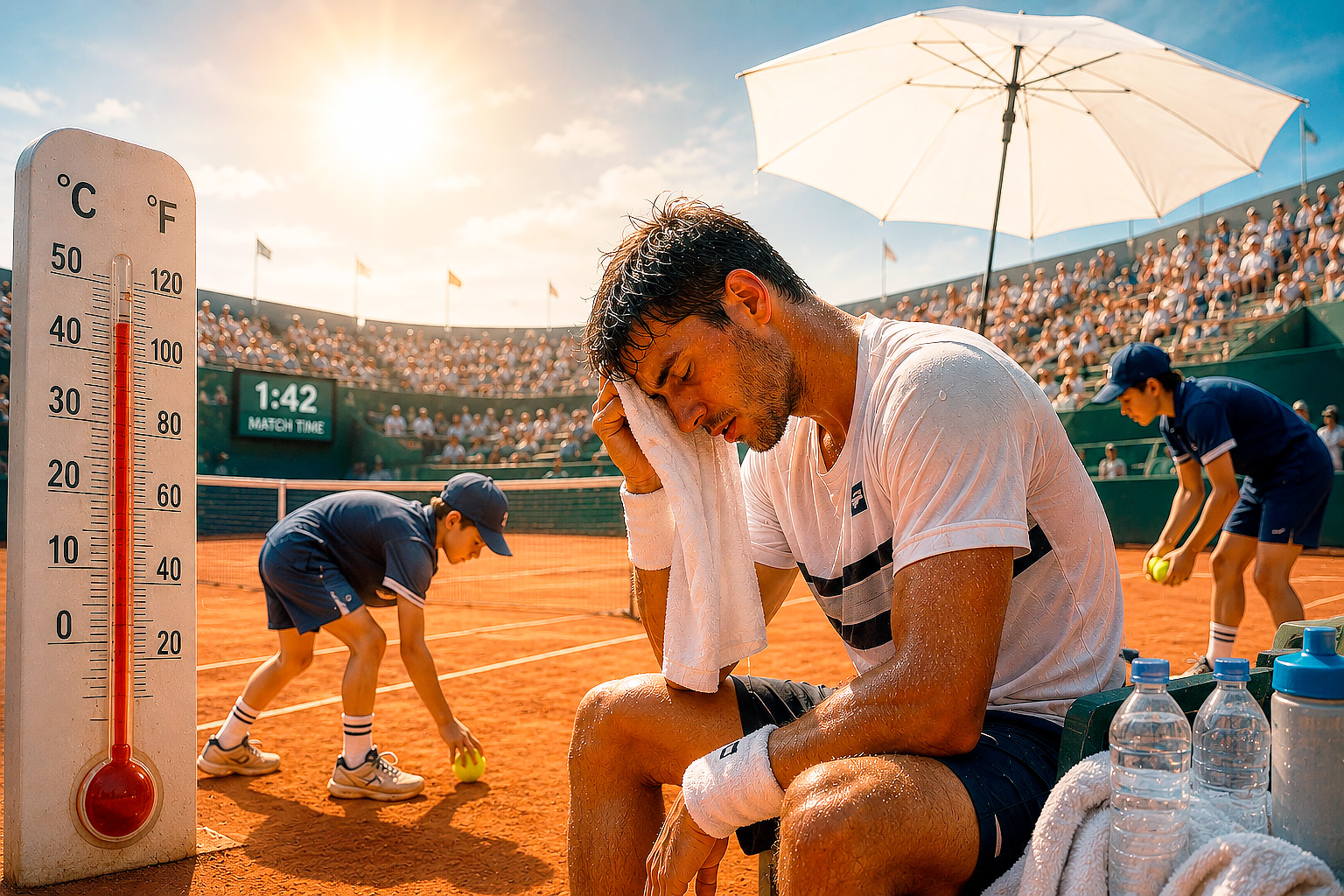
Almost every season brings news of players playing in temperatures above 35°C, with hard court surfaces heating up to 50°C to 60°C. Doctors are increasingly being called into the arena, while athletes complain of dizziness, cramps, and severe dehydration, forcing organizers to change competition schedules. Climate change is gradually becoming a factor affecting not only player comfort but also the organization of training and tournaments.
Tennis occupies a unique place among team sports. Football has breaks and substitutions, basketball players regularly rest on the bench, and volleyball rallies last mere seconds. A tennis player, however, can spend three, four, and sometimes five hours on the court with virtually no opportunity to fully recover. Throughout the match, they constantly accelerate, sharply change direction, execute dozens of powerful shots, and are exposed to direct sunlight. Under these conditions, the body must simultaneously supply energy to the muscles and continuously cool itself. When the air and surface temperatures become too high, the thermoregulatory system reaches its limits.
However, air temperature isn’t always the primary factor. Experts evaluate several factors simultaneously: humidity, wind strength, solar radiation intensity, and the surface temperature itself. Hard courts are particularly challenging, as they actively absorb solar heat and become significantly hotter than the surrounding air. This is why athletes often feel temperatures much higher than those indicated by a standard thermometer. It’s no coincidence that many players admit that the toughest matches of their careers weren’t played in record-breaking temperatures, but rather in a combination of high humidity and a scorching surface.
During a long match, a professional tennis player can lose several liters of fluid. Along with sweat, the body loses not only water but also sodium, potassium, magnesium, and other vital electrolytes. If these losses are not replenished promptly, the first signs of overheating appear: impaired concentration, slowed reaction times, muscle cramps, headaches, and dizziness. Heat exhaustion can then develop, and in the most severe cases, heatstroke, which poses a serious threat to the athlete’s health.
Interestingly, sports medicine research shows that even before significant physical fatigue sets in, the ability to make quick decisions begins to suffer. Players are more likely to make mistakes when choosing the direction of their shots, react later to the ball, are less able to judge its speed, and make risky tactical decisions. It may seem as if a tennis player has suddenly lost their game, but in reality, it’s not the muscles that begin to suffer, but the brain.
Such cases in world tennis have long ceased to be a rarity. On the Australian Temperatures exceeding 40°C were repeatedly recorded at the Open . Players reported that the soles of their shoes literally softened on the scorching surface, and some matches ended with athletes receiving IV fluids immediately after shaking hands. In the summer of 2026, an incident involving Ekaterina Alexandrova caused a stir. During a match, the athlete became ill due to the extreme heat, was unable to leave the court, and was taken away in a wheelchair. This incident once again prompted experts to discuss the need to revise existing rules for holding competitions in extreme temperatures. And such stories are becoming increasingly common, regardless of the tournament’s level or the athletes’ rankings.
The heat doesn’t discriminate between the world’s number one and number 100. Novak Djokovic has repeatedly stated that he places great emphasis on cooling his body between games, using ice, special cooling towels, and carefully selected beverages. Carlos Alcaraz admitted that recovery after hot matches has become one of the most important components of his summer season preparation. Iga Świątek noted that in extreme heat, hydration must be monitored much more closely before hitting the court. Even perfect physical fitness does not negate the laws of physiology. This is why not only athletic training but also the work of doctors, physiotherapists, and sports nutrition specialists is becoming increasingly important.
 © AI
© AI
The response to this new reality was the emergence of special protocols known as Heat Rule or Extreme Heat Policy. At major tournaments, they allow for additional breaks, extended medical care, delayed match starts, closed roofs at central arenas, and even completely altered matchday schedules. Such measures are being used particularly actively at the Australian Open, where extreme heat has become an almost annual occurrence.
However, many experts believe that the current rules may not be sufficient in the future. Discussions are increasingly focused on moving play dates to earlier in the morning, increasing the number of evening matches, and even changing the calendar of individual tournaments. If the trend toward rising average temperatures continues, such measures could become a regular part of world tennis.
This issue requires particular attention in children’s and youth sports. Children’s bodies cool down less efficiently than adults, and they are often so engrossed in their games that they simply don’t notice the first signs of overheating. Therefore, responsibility falls entirely on adults. Coaches and parents should ensure that young athletes drink water regularly, wear hats, rest in the shade between matches, and promptly replenish lost fluids and electrolytes. At the first sign of illness, training or matches should be stopped. No victory at a junior tournament is worth a child’s health.
Summer in Moldova is also getting hotter, and during competitions, temperatures can often exceed 35°C with high solar activity. This means safety issues must be given as much attention as the training process. Sometimes it makes more sense to move training to early morning or evening, shorten the duration, increase the number of breaks, or even skip training entirely during the hottest hours of the day. Such decisions should not be considered a sign of weakness. On the contrary, they are precisely what helps preserve an athlete’s health and ensure their long-term development.
Tennis has always been considered a sport where character, skill, and physical fitness prevail. However, today, players’ main rivals increasingly include another factor beyond their control: ambient temperature. Climate change is gradually changing tennis. Organizers are revising regulations, doctors are developing new recommendations, and coaches are learning to plan athletes’ training differently.
It’s possible that very soon the most important question before a match will be not only the players’ fitness, but also the weather’s readiness. And the sooner the tennis community learns to embrace this new reality, the safer our beloved sport will be for professionals, juniors, and millions of amateurs around the world.