In modern tennis, simply “playing well” is no longer enough. To properly organize the schedule, select opponents, objectively assess the level, and track progress, a clear benchmark is needed. This is precisely why the ITF World Tennis Number (WTN) was created. WTN is a global ranking system that helps communicate tennis in a common language across the globe. The WTN was developed by the International Tennis Federation as a unified system for players of all ages, genders, and skill levels. Its idea is simple: to make tennis more accessible, understandable, and fair for everyone.
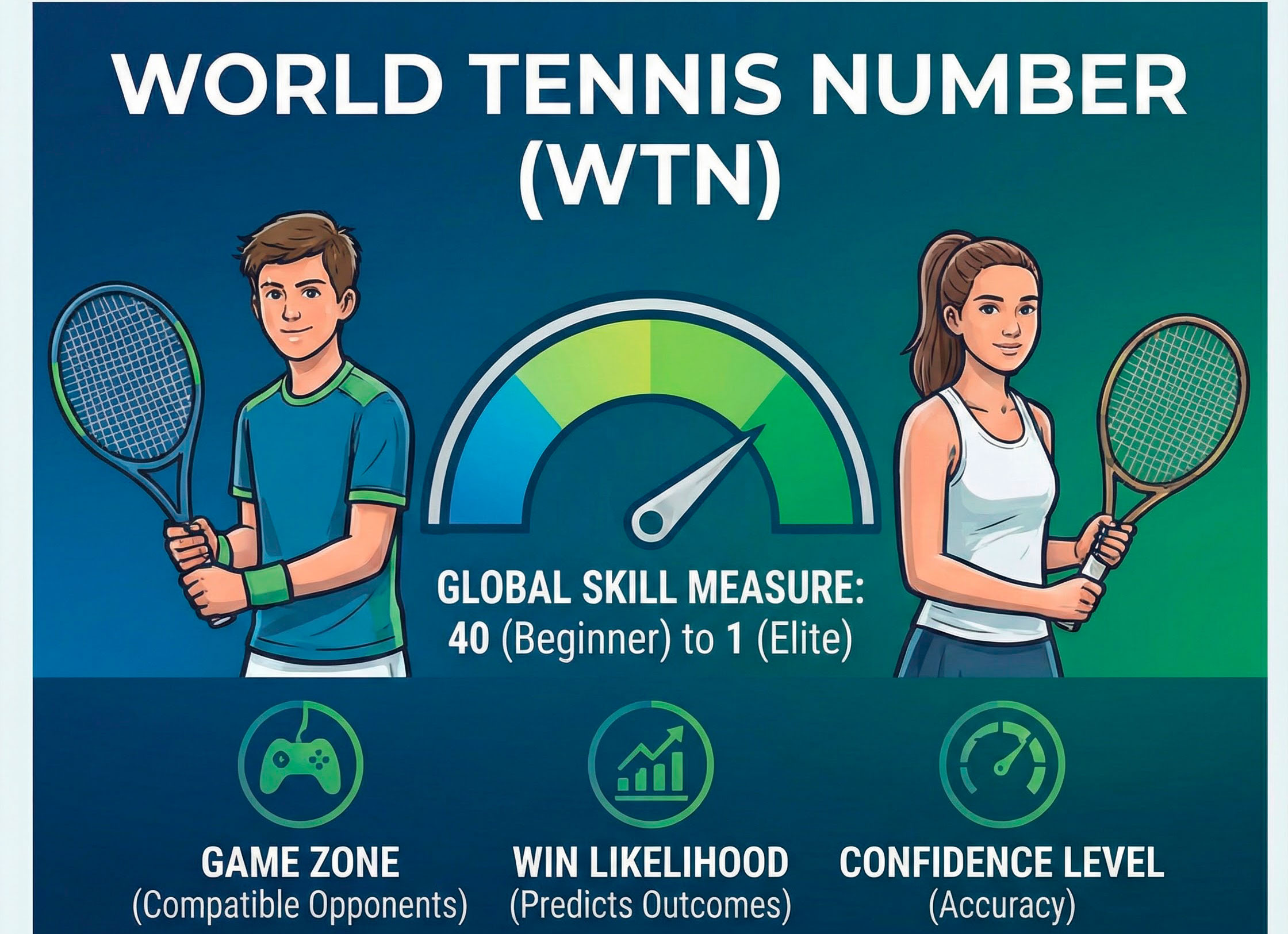
Simply put, WTN is your playing level in numbers. The scale goes from 40 to 1:
40 is a beginner player,
1 is the level of the world’s best professionals.
Each player has a separate WTN in singles and a separate WTN in doubles, as these are two different types of tennis with different specifics. The idea behind the system is to help match players not by age, last name, or tournament status, but by their actual level of play.
Many are accustomed to classic rankings, where a lot depends on how many tournaments you’ve played and how many points you’ve earned. WTN is structured a little differently. It’s not just a list of points, but a real-time assessment of your playing skill.
The system analyzes match results, opponent strength, set totals, and a player’s recent performance. Importantly, the algorithm looks not only at the match outcome but also at each individual set. This means that even if a match is lost, the set won still counts for your score. Updates occur weekly, and as more matches are played, the score becomes increasingly accurate and “confirmed.”
The main problem of amateur, club, and even junior tennis has always been the same: it’s incredibly difficult to find an opponent at your level . One match is too easy, another is hopeless, and the third seems interesting, but it’s more of a fluke.
WTN is trying to solve exactly this problem. Each player has their own Game . zONe – a range of opponents with whom a match is highly likely to be competitive and interesting. In other words, the system doesn’t just provide a number, but helps you understand who you should really play against to ensure the match is both rewarding and exciting.
For the player himself, this provides several advantages:
- a clear starting point;
- the ability to see progress objectively;
- fairer selection of opponents;
- more interesting matches;
- fewer random “defeats” and more useful gaming practice.
For young players, WTN is especially useful because it removes some of the usual confusion. A child may be strong in their age category, but parents and coaches don’t always understand what level that is in the broader context .
WTN helps you see not only your ranking within a category but also your overall playing level. This is useful for planning tournaments, selecting sparring matches, assessing progress, and moving on to a more serious competitive stage. Furthermore, WTN’s role is already growing internationally: the system is used in player admission procedures for ITF tournaments, including the professional World Tour . Tennis Tour for singles when fulfilling verification requirements, and in the ITF Junior Tour it can be used as a secondary criterion in the absence of a junior ranking.
For a coach, WTN isn’t just another number in a player’s profile. It’s a tool that helps them make smarter decisions.
Firstly, WTN provides a more accurate understanding of a player’s current level. Secondly, it helps select suitable matches and sparring sessions. Thirdly, it allows for tracking dynamics rather than relying solely on the subjective impression that “it seems like he’s playing better.”
For clubs and coaches, it is also a convenient base for:
- level tournaments,
- training leagues,
- box leagues ,
- internal distribution of players into groups,
- clear and honest sowing .
It is no coincidence that ITF materials describe WTN as a universal standard for players, coaches and clubs, which makes competition fairer and participation more accessible.
For parents, WTN is useful primarily because it removes unnecessary illusions and unnecessary anxiety.
Sometimes, after one successful tournament, it seems like a child should only play at the top. Sometimes, after a few losses, it feels like everything is going wrong. WTN helps you look at your development more calmly and objectively. It’s not a magic formula or a final verdict, but it’s a good benchmark that shows where your child is now, how stable their level is, and how it’s changing over time.
This is also important for families because it helps them better set expectations—not based on the emotions of a specific match, but on the overall development.
How a player gets his number
WTN can be earned and developed through matches played. The Moldovan Tennis Federation registers players in this system itself. The system uses official results from tournaments, leagues, and other approved formats. A Rate tool is available for new and amateur players. My Game – a starting self-assessment that helps you gain a baseline level before accumulating a full match history. As a player plays more matches, the system refines their number, and their trust level increases.
WTN isn’t just a number. The platform also offers players access to practical tools. These include:
- results history;
- personalized level change schedule;
- head-to-head comparison ;
- Subscribing to friends and potential rivals;
- setting up your own profile;
- My function Matches , which allows you to upload results from matches played outside of official tournaments, such as with friends, teammates, or training partners, if they are also registered in the system. Once confirmed, these results may also be reflected in WTN.
The Moldovan Tennis Federation has been participating in the WTN program for several years now, and for us, it’s more than just an international “fashionable acronym.” It’s a working tool that’s gradually helping to make tennis more systemic in the country.
The more widely WTN is used, the easier it is:
- navigate the real level of players;
- build fairer competitions;
- help juniors find the right competition level;
- to develop club and amateur tennis;
- integrate Moldovan players into the global tennis system.
Simply put, WTN makes tennis more accessible to beginners, parents, coaches, and even competitive players.
The main thing to remember is that WTN is not a replacement for a coach, a ranking, or a label for a player. It is a tool that helps tennis become fairer, more accessible, and more convenient for everyone.
One court. One sport. One common level.
And the better players, coaches, and parents understand how WTN works, the more useful it becomes in real life—not on paper, but on the court.